The murder of Charlie Cavendish
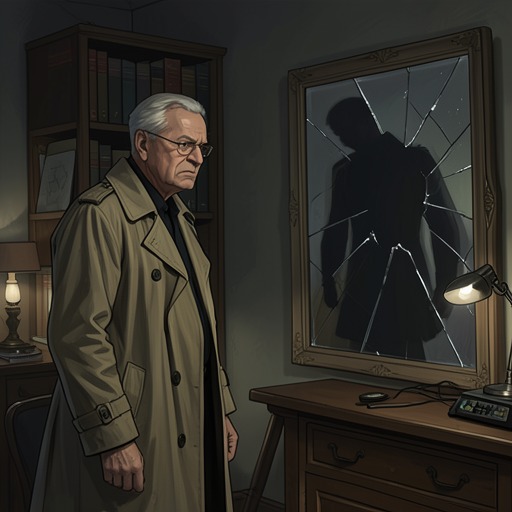
The IPCRESS FileCharlie Cavendish’s murder turns a borrowed light-blue raincoat into the hinge between a personal friendship and a network’s violence. The first account reaches the unnamed narrator not through an investigation scene but through a radio bulletin: police want to interview a man seen near the crime, and the description is of the narrator. Later, the narrator explains to Jean that Charlie was killed because he wore the narrator’s coat. The event’s eventual account therefore shifts the question from who the police are looking for to how an intended target and a friend were confused, and how Jay’s network became involved.
The murder enters the account
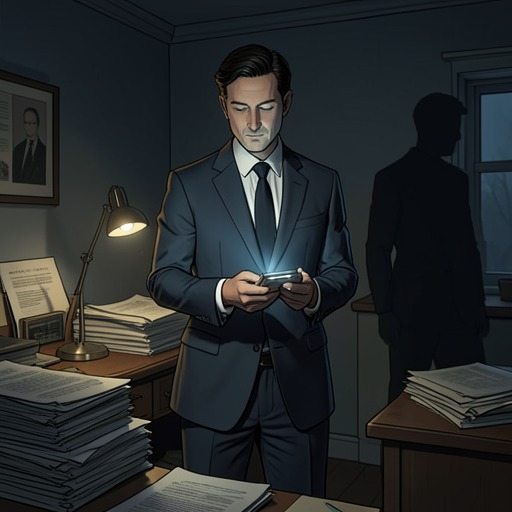
The narrator hears the police appeal while Jay is speaking about capitalism. The political argument continues, but the radio’s description of the wanted man breaks through it; the narrator’s attention moves at once from Jay’s speech to the crime. He asks Jay who killed Charlie. The timing makes the news bulletin more than background: it puts the narrator under suspicion while he is face to face with someone whose network will later be linked to the killing.
Jay goes to the window and beckons the narrator over. Across the street are two taxis, with a single-decker bus farther down the road. Jay switches on an FM radio and tunes it to the police wavelength. A police walkie-talkie outside the Victoria and Albert Museum is coordinating movements. The scene gives the narrator evidence of active police attention, but not a resolution. When Jay says that all of them were responsible, he enlarges the question beyond the identity of the person who carried out the killing. His remark does not establish that he personally arranged it; the later account explicitly separates Jay from the direct arrangement.
The mistaken identity
The newspaper account labels the case the London Club Murder. Although the papers are playing it down, the murder still attracts public attention. Police are going through the membership books of the Tin-Tack Club, where Charlie worked part-time as a barman. The club’s records offer an institutional route into the case, while the radio appeal has already made the narrator himself a person police want to interview.
In conversation with Jean, the narrator supplies the specific circumstance that explains Charlie’s death. Charlie had lent him clothes, including a light-blue raincoat. The narrator returned the coat to Charlie at Fortes; Charlie wore it when he left and went home. The narrator describes the result as a simple case of mistaken identity. The coat’s movement from one man to the other clarifies why the narrator’s description could matter to the police and why Charlie, rather than the intended person, was killed. The account identifies the confusion but does not add details about the killing itself.
Jean asks who arranged it. The narrator attributes the arrangement to a hoodlum working for Jay’s network and says that they will pick him up. This is a stated intention, not confirmation that the person is later captured. The distinction matters: the account points to a specific agent within the network but supplies neither the hoodlum’s name nor a completed arrest. Charlie’s death is thus explained at the level of the network and the mistaken identity, while the immediate perpetrator remains unidentified by name.
Jay, Dalby, and C-SICH
Jean asks whether Jay himself arranged the killing. The narrator rejects that possibility, then explains Jay’s connection to what followed. Once Jay learned of Charlie’s association with C-SICH, he hurried to speak with Dalby. Jean suggests that Jay hoped Dalby could make the matter disappear; the narrator agrees, while noting that Dalby had little chance of doing so. C-SICH has numerous direct government connections, through industry as well as its combined-services side.
This exchange distinguishes different kinds of responsibility. The killing is attributed to a hoodlum who works for Jay’s network, but Jay is not presented as the person who arranged it. His subsequent approach to Dalby is linked instead to Charlie’s C-SICH connection and an attempt to contain the consequences. The passage does not establish precisely what Jay told Dalby or what Dalby did; it does establish that Jay acted quickly once he learned of Charlie’s affiliation, and that the narrator regards C-SICH’s institutional connections as an obstacle to suppressing the matter.
Friendship and the limits of the account
The murder is also disclosed through the narrator’s guarded conversation with Jean. Jean says Murray described Charlie as a close friend of the narrator. The narrator confirms that Charlie had warned him when he was in danger, but withholds the fact that anyone else had warned him as well. That omission places the friendship within the narrator’s larger practice of controlling what he reveals, even to someone who is asking directly about Charlie’s death. The account establishes Charlie’s warning as an important part of their relationship without explaining its circumstances here.
The event’s facts arrive in stages: first a public appeal that identifies the narrator, then a private question to Jay, and later a reconstruction given to Jean. That sequence leaves the reader to revise the apparent case against the narrator. The raincoat makes the police description intelligible; the network connection identifies who arranged the killing; and Charlie’s C-SICH work explains why Jay went to Dalby afterward. The ending is not a solved investigation: the narrator expects the hoodlum to be picked up, but the evidence supplied does not report that outcome. What the account does resolve is the central misidentification, while leaving the promised recovery of the direct perpetrator unconfirmed.